

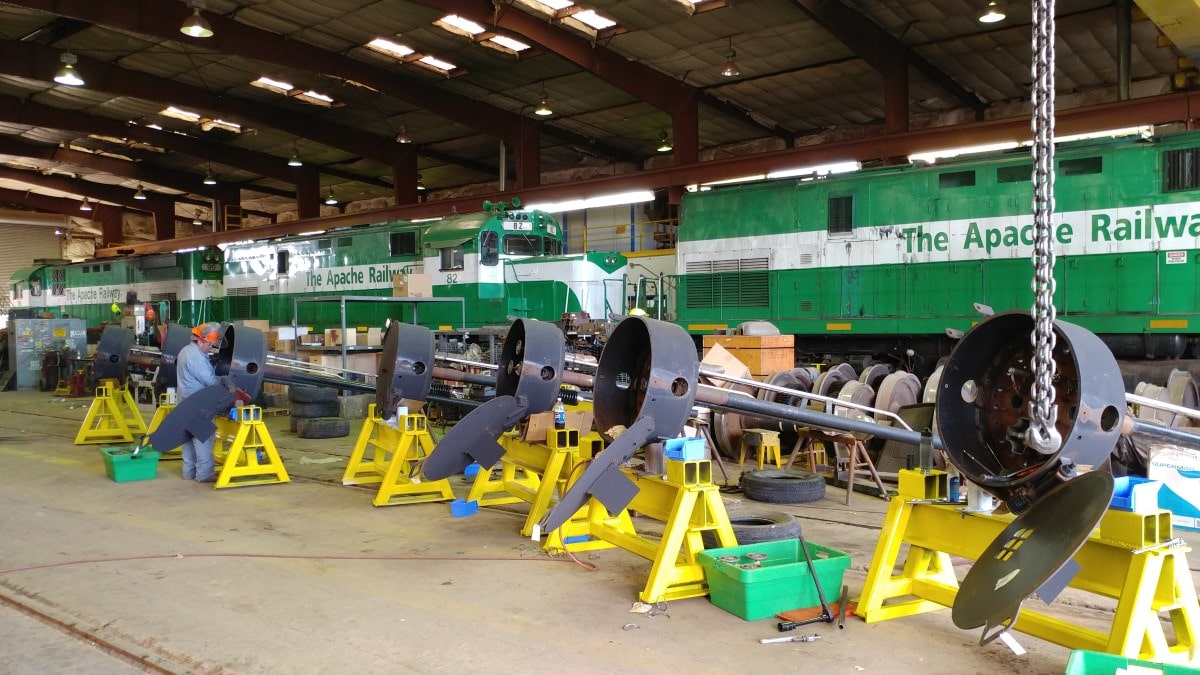
Railroads carry the bulk freight that keeps industries running. Tank cars are a big part of that system, moving liquids and chemicals across the country. But all rail cars have running gear which must be maintained to strict safety standards. Before any of those cars can be interchanged, they have to be inspected and maintained under strict federal reliability safety standards.
Rail cars requiring operating repairs are generally identified in service by shippers and railroads. Once identified, they are ‘bad ordered’ to repair shops. In the Apache’s case, BO cars are a key part of our business. The BO cars that we handle range from gondolas, to boxcars, to hopper cars, to tank cars. There are specific requirements imposed by the FRA and AAR on tank cars, and only facilities like the Apache, which are certified to repair tank cars, can work on BO tank cars.
Once every 10 years of service, the process of confirming a tank car safe and legal to operate is called railcar qualification.
Tank car qualification is a term included in regulatory documents, but for fleet managers and shippers, the meaning is straightforward: rail car qualification is the process that proves a tank car safe to use. Without it, a car can’t move in interchange service.
What is railcar qualification?
For shippers, qualification is what proves a tank car is still roadworthy. The process isn’t a single inspection—it’s a full cycle of checks and records required by the FRA and AAR to keep cars compliant.
When a tank car comes in for qualification, inspectors run through several steps, all of them specified by tank car owners and lessees:
- Visual inspections – crews inspect the jacket and tank shell, attachment welds, and fittings, noting any cracks, leaks, or signs of fatigue.
- Specialized tests – media blasting, and ultrasonic and magnetic particle non-destructive tested methods are used to uncover flaws that aren’t otherwise visible.
- Hydrostatic pressure check – the car is filled and pressurized to show it can safely handle service conditions.
- Service equipment – valves, gaskets, and relief devices are pulled and either adjusted, repaired, or replaced to meet reliability requirements.
- Documentation – inspectors log reports, dates, and next-test intervals so each car’s record remains traceable.
The FRA and AAR typically require tank car qualification every 10 years, with certain tests at 5-year intervals depending on the commodity and the type of tank car. Skipping or delaying qualification means a car can no longer be interchanged — it has to be repaired or sidelined until compliant.
For car owners, qualification is both a regulatory requirement and a business safeguard.
How to prepare for railcar qualification
Because qualification is a scheduled requirement, preparation goes a long way in keeping fleets compliant and minimizing downtime. Owners and fleet managers can get ahead of the process by:
Planning ahead for shop capacity
Qualified facilities like The Apache Railway Company handle both repair and qualification, but capacity fills quickly when large groups of cars are due at once. Getting cars on the schedule early prevents bottlenecks and keeps the flow of work steady.
Bundling work when possible
When cars are in for qualification, other necessary repairs are completed: brakes, couplers, or structural welding. Bundling work saves on shop fees and reduces additional downtime later. All work is done to customer specifications.
Preparing documentation
Prior to shoping a tank car, owners provide car shops with tank car Certificates of Construction, repair and equipment specifications, and cleaning standards. When that paperwork is in order, the shop can move faster and there’s less risk of delays from missing files.
Why complete tank car qualifications early?
Waiting until the last minute is a recipe for delays. Shops can only handle so many cars at once, and when a large number of tank cars come due in the same season — as often happens — bottlenecks are inevitable.
By scheduling qualification ahead of deadline, car owners gain:
- Assured shop time – no waiting on a backlog when compliance dates are near.
- Flexibility for repairs – time to address unexpected issues that surface during inspection.
- Reduced liability – less risk of a car slipping out of compliance and being sidelined.
- Operational continuity – fleets stay available, reducing the chance of service interruptions.
It’s the same principle as preventative maintenance: deal with issues on your own schedule, not when they force a crisis.
The Apache Railway Company’s role
As a certified short line with AAR M-1002 and M-1003 credentials, The Apache Railway Company performs full tank car qualification and inspection services at its Snowflake, Arizona shop. Our teams perform pre-qualification cleaning, and handle everything from non-destructive testing, to valve repair, running gear inspection and repair, and provide full documentation, ensuring cars meet FRA and AAR requirements.
Because we also offer railcar repair, cleaning, and storage, Apache provides a one-stop location where car owners can qualify, service, and stage their fleets without moving them across multiple facilities. That saves time, reduces costs, and keeps cars compliant for interchange.
Conclusion
For car owners, BO repairs, and tank car qualification is really about keeping freight moving without surprises.
With certified facilities and integrated services, The Apache Railway Company helps customers in the Southwest and beyond manage this process smoothly and efficiently.
Learn more about Tank Car Qualification & Inspection at Apache